Nightmare at the Pricing Street
Given the recent geopolitical and economic developments, we have been facing a surge of bad news, with constant increases in pricing being one of them. Based on the Eurostat publications in February 2022 producer prices in EU rose by 31.1% compared to the same month last year. Producer prices change measures the average change in the price of goods and services sold by manufacturers and producers in the wholesale market during a given period. A solid measure can be Harmonized Indices of Consumer Prices (HICP). “HICP measure the changes over time in the prices of consumer goods and services acquired by households. They give a comparable measure of inflation as they are calculated according to harmonized definitions”. March 2022 HICP is showing overall index of 7.4% with housing, electricity and gas leading the ”pack” of increases by 17.3% and transportation by 14.6% respectively. Furthermore, what EU Central Bank tells us in their latest communication is that “negative EURIBOR period” will end with 2022, and that in 2023 we will see moving in positive realms of interest rates. This change on top of pricing changes which are happening currently will generate great changes in the consumer habits (more money allocated to bank loan repayments, less disposable cash for other things), business practices, product design and ultimately will create new opportunities for business that will be able to adapt fast and make the right decisions.
As a consumer I personally already saw most of the % mentioned above reflected on the store shelfs. My personal feeling somehow is that the % are even bigger versus what is statistically reported, but this is just my personal feeling. Ultimately all of this got me thinking – what would be the process of coping with the need to price up? Should it be structural, to have the most out of it – whatever the “most” is.
I identified 6 actions which can help consumer goods/service companies to respond to today’s inflation. Basically, systematic implementation of these 6 actions (challenging these) would create a system in place to cope with the existing and coming changes.
- COGS re-examination: in the environment where there is a constant change in cost and availability, with supply chain uncertainties, you need to allocate organization responsibilities to monitor and make decisions about all mentioned: a) costs b) availability c) logistic aspects d) suppliers. This means that you need to investigate new suppliers, new solutions in logistics, and concede to different contractual agreements (what you are/were used to), which will improve predictability for your business. Having better predictability will help you greatly in making better business decisions.
- Product/Service formulation: as some parts of your products are unavailable, semi-unavailable, available at a different price point, that puts your R&D/product-service design departments on full alert, you need to have a constant evaluation if there Is a necessity to change formulation of your product/service, how and when? Just recently we have seen the shortcomings in availability of sunflower oil, pushing the price on this commodity, and therefore changing the focus of dealing with the producers of a similar product - palm oil. In the aftermath, Indonesia (as one of the world biggest producers of palm oil) banned all exports of palm oil products. All these changes happening just within a couple of months. This is the reality production companies are currently coping with, so having the right people/organization capable of solving such problems should be on the top of your agenda.
- Cost Transposal: as price increase becomes an inevitability, systematic approach for passing through the cost towards your customers/consumers is needed. When I say systematic approach, I mean that in customer case, you need to build your explanation in a way that captures fair value and allows profit sharing between your company and customer in the ratios of pre-inflation margins.
- Magic Price Point crossing: A lot of companies have built their pricing strategies based on the “magic price point” ideas. Basically, the idea is “if product A crosses the price point X, we will lose sales and market share”, and to be honest this is right in most cases. But, having the today’s inflation on our plate, you need to support the idea of crossing the predetermined price points, and you need to unlock this way of thinking for the responsible people if needed.
- Pricing Prioritization: Make sure you balance out between the product/service price increase and reductions in promotional activities. This is naturally connected to your understanding of category economics, your company’s P&L and overall financial position, and COGS fluctuation. Minor price change would most likely drive a different decision versus a major increase.
- Differentiate Price Increase: Detailed understanding of category economics (using BI & Revenue and other tools) will help you differentiate, and custom create your price increases between categories, subcategories, hero products, and promoted one’s. This way you will be able to have the best possible pricing mix/margin effect.
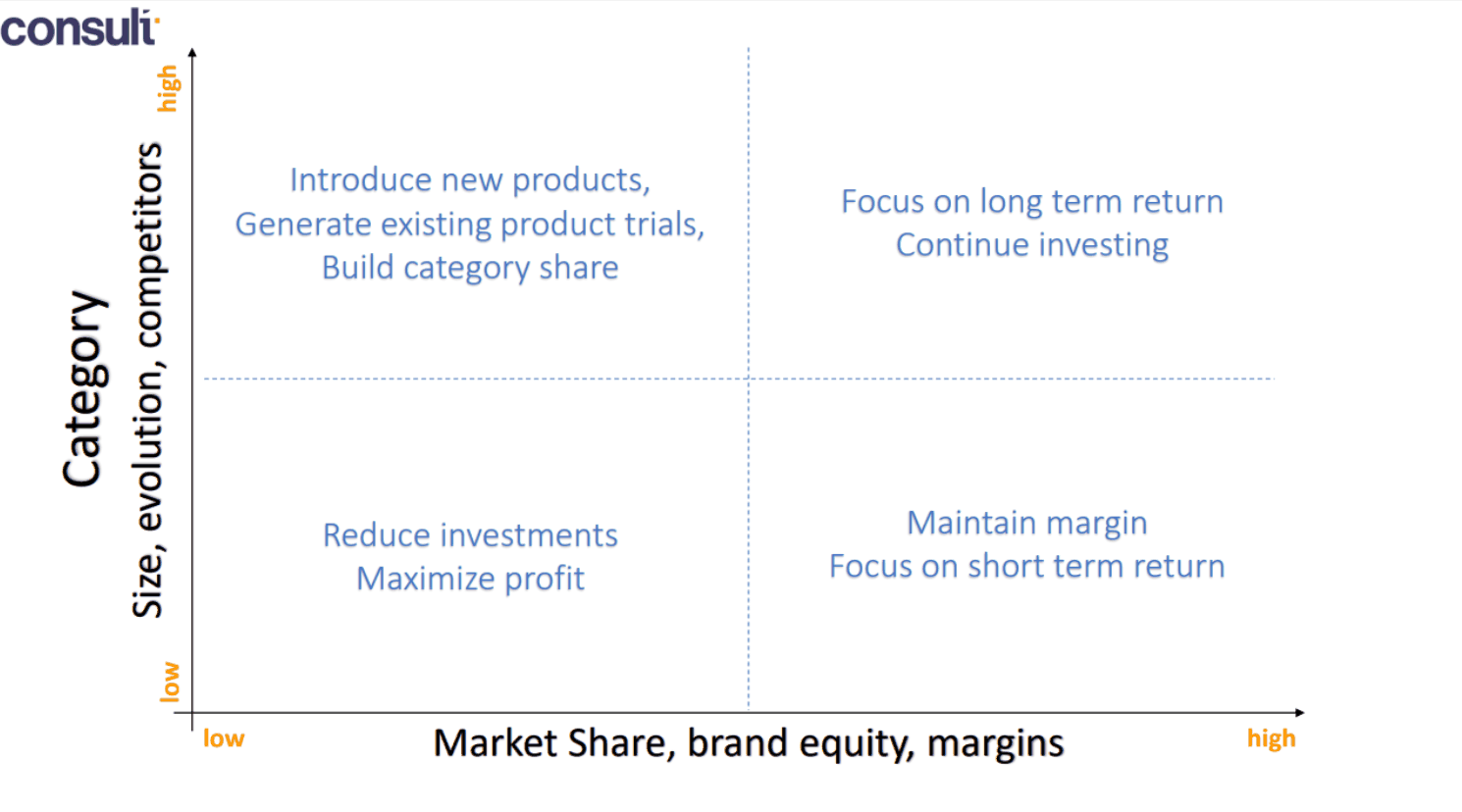
Now, that you have created a respond system with 6 actions listed above, and maybe the ones which are natural for your category/business, there is work to be done on guiding the teams to help determine price tactics, help pricing moves and decide on the magnitude of changes. For this reason, I include a simple 2x2 table below, which can give you some ideas on potential goals for your business. Of course, a specific table can be designed for your business, but I don’t recommend investing too much time in detailed development and criteria, as conclusions are often self-explanatory and maybe intuitive for someone who is familiar with the category.
Potential goals
At the end, I would like to remind you of one aspect, which I haven’t seen too much mentioned among the researchers of pricing activities. This aspect is organization motivation. Discussing with a friend of mine I understood that company that employs him announced a price increase of 15% to the customers, but also announced a salary increase for the employees in the range of 1.2%. They did a solid job in most of 6 actions mentioned above, communicating fairly to their customers, having the profit-sharing idea working in their common favor, etc... What they didn’t do is to make sure their organization stays motivated, as their employees in fact can buy less of their products with the announced changes of prices and salaries. Protecting the business actions needs to start with protecting the people who make this business, or at least to go hand in hand with the business actions.