
Guide for FMCG, FS, OTC brands entering West Balkans
Before going into more details of the process, let’s firstly look into some main statistical data of the region which is called West Balkans (Europe). Countries which are part of West Balkans region are: Bosnia and Hercegovina, Serbia, Montenegro, North Macedonia, and Albania. Total population of this region is 17.6M, based on the latest published statistics, which is comparable to Netherlands, a bit smaller than Romania, and considerably larger than Belgium, Czech, Greece, etc. It’s worth noticing that most of the countries in West Balkans haven’t done official population count for years for different reasons (mostly a political decision), so in reality the number is for sure lower (as a result of emigration, depopulation), but still a respectable market as a whole. I will not comment on general macro economical indicators as these facts would not (in most of the cases, have to be an honest) have determining factor when deciding whether to enter the region or not. Most of the countries in the region offer substantial government subsidies and overall support for foreign investors opening production facilities, so given the overall current increase in cost of production, it is nevertheless quite a good solution from the optimization point of view, bearing in mind the subsidies and the overall cost of doing business in comparison to other parts of Europe, intercountry trade agreements, geographical position, but this would be another topic and a completely different article.
Let’s get back to what is the topic of today which is a guide for FMCG, Food Supplement and OTC brand willing to enter West Balkans. Below are the steps, I recommend for every company to make in order to strike the highest possible success rate in building a long-term successful presence in the region.
1. Long Term successful presence
I would start from this point, as brands with opportunistic approaches to the market have seen a lot of failure in the past years. Opportunistic being the opposite from long term presence, there will be almost no success if you don’t treat this region and the countries comprising it, the same as you treat the likes of comparable regions/countries you are already present in. There will be a need for investment both business and organizational-wise, so you need to have a decision that for you this is a long-term project vs a short business “fling”. So, nr1 decision is – “I am willing to build a long-term presence and allocate resources to achieve it.”
2. Consumers
Overall consumer is traditional and let me try to explain what traditional means. I would have to divide the FMCG from FS and OTC consumer preferences here. When it comes to the fact that FMCG consumers are less prone to try new products if you look at the number of brands and products in the region, it’s much lower on average vs some other countries in Europe. Some studies connect this to the “risk level” which average consumer is willing to undertake, but regardless of the cause, product and brand trial is not easy for FMCG newcomers. On the other hand, when it comes to FS and OTC preferences, it’s clear that average consumer is open to try new products, with self-medication and self-diagnosis representing an overwhelming habit within population. Traditional ingredients have good acceptance. Average consumer still loves brands, but this ratio is diminishing in the recent years, with cost effective mindset kicking in – discounters and private label steadily growing as a result of their increase in: presence (distribution) and quality. LIDL has entered the biggest country in the region, Serbia, just a couple of years back to get to the 2nd position in the retailer market, announcing plans to enter Bosnia and Hercegovina. North Macedonia has a local group of discounters which depending on FMCG category represent 20-40% market share and growing. In a nutshell two things to take out from the overall consumer overview is: traditional, cost-effective mindset. Take time to understand the specifics of local consumer, there are good local companies which can help you run your analytics and give you enough information to validate “proof of concept” for your presence in the region. Not having a good marketing strategy and resources to support it would likely leave you short from achieving whatever goal you have targeted.
3. Regulatory Acts
Local regulatory and customs are complicated by the sheer fact that each country has its own regulatory requirements, not to mention that in some countries, there are additional local entities with regulatory requirements of their own. All the countries in the region have declared their intention to join EU, so there are some parts of regulations which are in harmony with the EU requirements and having proof that your product is produced in Europe for example could get you a preferred customs rate in most of the countries. Key word is “most” – specifics apply by country/category. In the case of Food Supplement and OTCs it becomes even more complicated with different administrative bodies overseeing provision of permits within different countries, less overlapping with EU regulations. Simply, you need local expertise to understand a) registration process b) documents required c) cost related to startup and ongoing business. This expertise you can get from a distributor partner (that could be a part of a bidding process as well) or from a local regulatory agency. A special watch-out – in terms of giving a Market Authorization grant to a partner in FS/OTC category, double check how you can facilitate any future change, as this could prove extremely tricky within the local administrative bodies, so make sure your solution is giving you all the flexibility you need.
4. Distributor network
There is a substantial number of FMCG distributors covering mass retail, few distributors covering both mass retail and pharmacy market, and quite a few distributors covering pharmacies. So, in a nutshell a selection of distribution opportunities throughout the region. What I would advice here is to follow certain steps in choosing the preferred partner. Step 1 – what are the key business drivers for success? In the picture below, there Is an example for the pharmacy channel. You will need this if you want to set clear expectations in terms of delivery towards distributor and measure your success.
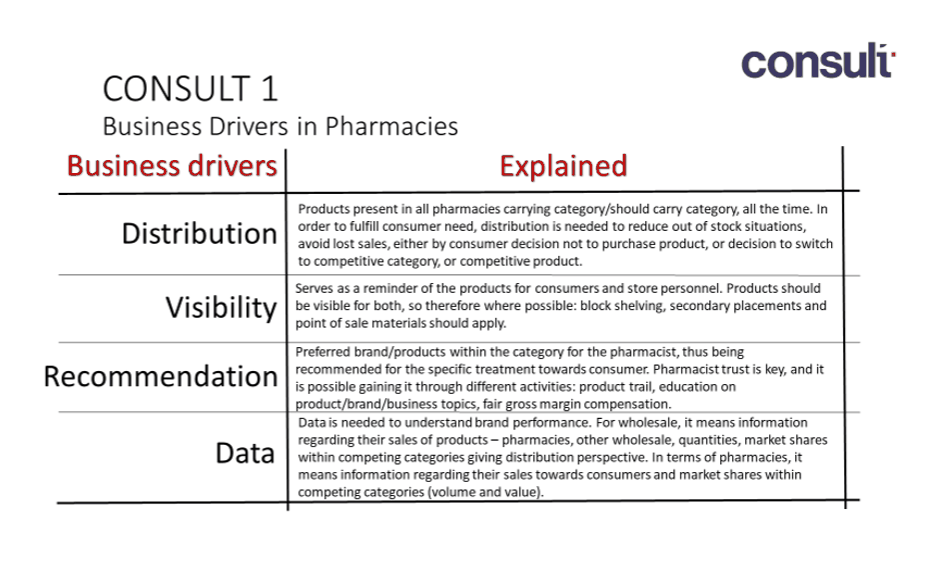
Step 2 – what is your ideal distribution partner looking like? I recommend you design the list of criteria important to your business and organization. A brief advice – don’t make a big list, make it impactful. To me for years the most important 3 things are: a) capability b) capacity c) collaboration, with ‘c)’ being the most important one. In West Balkans you will find a lot of partners which fulfill the 1st two criteria but don’t fulfill the collaboration – either because they don’t want to integrate new brands, or because it would consume too much energy to handle, or they just want to work without any overseeing. Anyway, having a large “shopping list” would most likely find you an adequate one. Step 3 – Cost of doing business – it depends on the category and the service required. I am not speaking here about the trade expenditure and retailer’s margin expectation. Most of the partners in FMCG are thinking in terms of margin %, neutral cash flow (be ready for extended payment days!) and not so much in terms of return on capital investment (bigger one’s only). Distributors covering the pharmacy channel are dominantly working as wholesalers, which gives them cost effectiveness allowing them to have slightly lower margin expectation. Step 4 – when you have done pinpointing the preferred partner list negotiate with the right people within the organization of your potential partner. Decision making power holders need to be defined prior to negotiation process, to avoid multiple meetings, data exchange and re-negotiations. Mainly, this is a result of a fact that most of the companies are privately owned, and still the owners are the key decision makers, meaning managers need to have a final approval.
5. Customer mix
Have no doubt West Balkans is already a Modern Trade environment in mass market and similarly progressing in the pharmacy channel as well. International and regional retailers are present throughout the WB, with local ones having the scale to gain needed attention and trade investments as well. Listing fees apply across the region, so I would estimate a solid 100k EUR only in listing of single FMCG brand with up to 10SKUs (the stated number would be valid only for niche category, if you would look for a bigger category, listing startup fee would build up significantly). Mass retail customers use the logic of front and back margin, while pharmacies mainly look for overall margin expectations, and as everywhere category expectations are different, depending on a number of factors. Make sure you have mapped out the retailers and have clear distribution expectation build up prior to entering the market. Be ready to compete on part of the market in the first years, to avoid unrealistic customer demands in some cases.
6. Value Chain Build Up vs Route to Market
In CONSULT1, we start our work in Value Chain building from setting the expected retail price as a result of product performance, marketing plan and competitive environment, moving to retailer margin expectation defined by category habits and positioning of the new brand, distributor margin expectation (in case of such route to a market) other “total delivery cost”. If such price can withstand the marketing investment needed and producer/brand profit expectations, we are set to deliver the product on the ground.