
Negotiations

Negotiations happen when there are multiple sides interested in dividing a certain value at a so called “negotiation table”. They happen all the time all over the place – at work, school, street, home, conference, pub, open market… and of course by sheerly mentioning the fact one logically concludes that negotiators are completely different – with different skills, experience and knowledge. So, we negotiate to agree how to divide the value put on the “negotiation table”.
What are the interesting open points which we are going to address in this article?
- Who are “we” (in “we negotiate...”), and what is the skill set we need to be able to successfully divide the value?
- How can we define the value we are negotiating?
- Negotiation table – and how to set one?
Who are “we” and what is the skill set we need to be able to successfully divide a value?
1st step – you need to understand who are the negotiators on both sides.
I start this process by mapping out visible and invisible negotiators. Process of negotiation often touches points which are not clearly visible from the start, which means that you could be facing not only the visible, but also the invisible ones. The Invisible ones are the force to be reckoned with. For example, you could be meeting a customer buyer, but within the customer hierarchy both finance department and finance manager are heavily influencing the deal making, therefore making them an important part of the customer team (visible or not). There are really endless potential examples. Especially dangerous are so called “fronts”, where you could face several fronts on the opposition side having a group of people within the organization you are negotiating with, which are leaning for a number of reasons to a certain outcome. Second, you need to understand the skill set, experience, personality and decision-making power of each and every participant on the other side of the table. Based on this information you will be able to draft the best possible team from your side of the table. “One size doesn’t fit all”. This information will help you decide who is the best team/individual to lead the negotiation on your behalf in terms of the same things mentioned above: skill set, experience, personality, and decision-making power).
2nd step – you need to understand what the interests of the negotiators are.
Different people, different interests. Again, not all the people on either side of the negotiations table have the same interest. Although it’s a business negotiation for example, don’t neglect the personal interests on both sides of the table. I have seen good deals break off, that would benefit both sides, as a result of personality traits of negotiators from both sides. Investigate the participants, try to understand their interest. This will help you design a proposal which will be more likely to be agreed on (of course not having in your heart compromising of the business interest)
How can we define the value we are negotiating?
And evenly important how can we get the most value of the deal?
1st step – let’s understand the value, and to understand the value let’s work on a “drawing board” to create the best possible proposal. When you create the proposal, calculate the value for both sides, and ask yourself the question “is this proposal taking the best possible value for both sides?”. Repeat the process.
My experience shows that there are 2 basic types of deal-design: 1) Value Enhancing 2) Value Taking. Value Enhancing proposals are working toward creating more value vs what was originally present on the table. For example: imagine that you are at a purely transactional negotiation, where the agreement is all about a service or a product which creates value to a certain extent to both sides. The question here for the participants is “what other value can be created?”, are there financial, logistic, or other clusters of value we could tap in the deal creation? Value Taking proposals are most likely linked to: a) predetermined positions of parties at the table (where one side is clearly more dominant than the other) b) personality traits of the negotiators (often, but not necessarily linked) to the point a). Value Taking is all about taking as much as possible from the value which is initially present on the table. This one is not my preferred option, as it often antagonizes the other party, making future deals less likely, or more costly if circumstances change. Some big retailers often undergo Value Taking position from early start e.g. Walmart – with opening lines like “We are X times bigger vs you!”
So, for 2nd step – I advise one to look into the Value Enhancing proposition, and what other value can be generated from the negotiation efforts of both sides. Quantify this.
Negotiation table – and how to set one?
Here are several dimensions. Who, where/how and sequence.
Who – we already elaborated this part and understand who are the participants (visible, invisible), fronts. Who is the best suited from your side vs the others’? – I am using plural, as negotiations can be between several parties as well, which is more complex to organize
Where/How – deciding on the place where the negotiations will be held is an important part of setting the “negotiation table”. If possible, always try to be the one who is setting the location, as this gives you a small advantage in enhancing a part of or the whole proposal, or would underline certain aspects of it, as you find it useful. “How” can also play a role here. On a different note for example – negotiations can use different models which are going to prevent the meeting itself/thus limiting the potential of compromise (I like to say that a compromise is nothing more than a LOSE-LOSE agreement). It can be done by auctions, reverse auctions, or other means.
Sequence – often neglected part in negotiations, but crucial. If your proposal is layered, make a decision in your preparation, who and when and in which sequence is going to lay out the proposal to the other side. It could be that your proposal is just too much to digest at once, but if laid out in smaller pieces could ultimately be agreed upon.
I am attaching a small form which can help in simple negotiations. For help in organizing more complex ones, or in case you would like to find out more on negotiation process, feel free to reach us at CONSULT1.
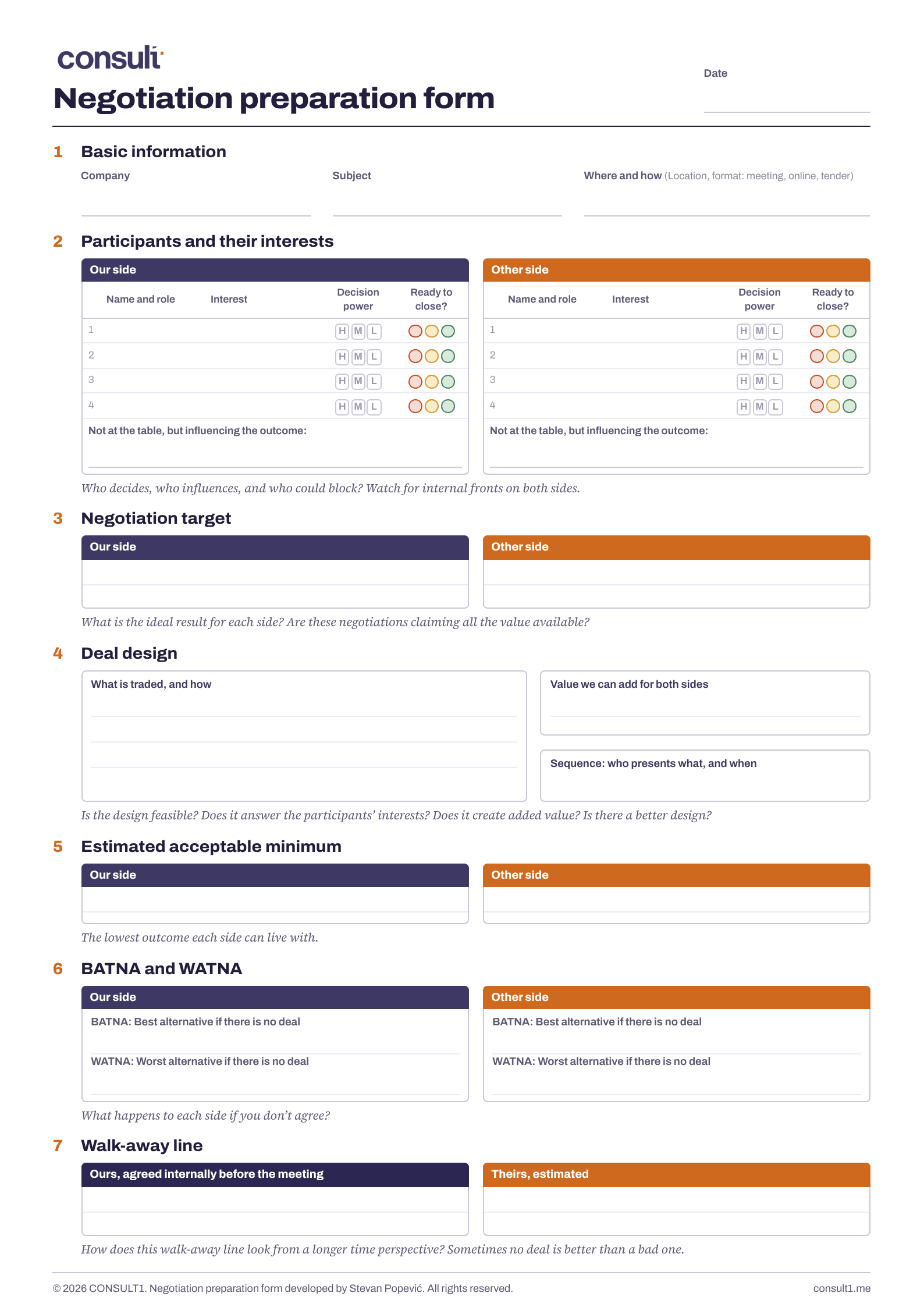
The attached document is pretty straightforward in terms of usage and filling – and as I said it’s fit to be used in negotiation between 2 parties/companies.
Important segments:
- Basic information.
- Participant list, their interest, your view on their willingness to conclude the deal (lights).
- Negotiation target.
- Deal design.
- Estimated acceptable minimum.
- B/WATNA (Best/Worst Alternative To Negotiated Agreement).
- Walk away line.
All segments are equally important, but my advice is to set for sure a “walk away line” prior to the meeting (and align, if necessary, with all relevant stakeholders within your organization). It’s better not to agree, sometimes, than to make a bad deal. When you enter a wrong train line, basically all stops are wrong ultimately.