
Return on invested time (ROIT)

In my previous article I briefly introduced ROIT concept. This time I will share my findings on this concept that I have been gathering, both personal and business-wise, for number of years. Furthermore, I will explain how this concept can help you improve your business performance, and also how it can help you personally better utilizing your time (or at least to understand why you don’t utilize the time in the way you would declaratively want to).
Below is a fairly simple 2x2 table. On X axis you have “invested time”, which equals amount of time you invest in certain task, project, business. On Y axis you have “return”, which equals the actual return on other available resource other than time.
What are now “other available resources”? I divided other available resources in 3 big buckets: 1) Skill set 2) Capital 3) Network. Difference between these other available resources and time is that time as a resource is limited and final, and all other resources are renewable. Skill sets are all the skills that you have acquired, and you are still (hopefully) acquiring. Capital is something tangible – cash, stocks, real estate, business, etc… Network is your people network, mostly people with whom you are regularly keeping contact, or in some cases where you are a sort of influencer. So, return on Y axis represents an increase on any of the other available resource during the period of time investment you choose to look into.
When you form a table like this, you actually get 4 types of behaviors, or 4 personas so to speak. I named these different personas: Realist, Idealist, Strategist and Hard-Working Realist.
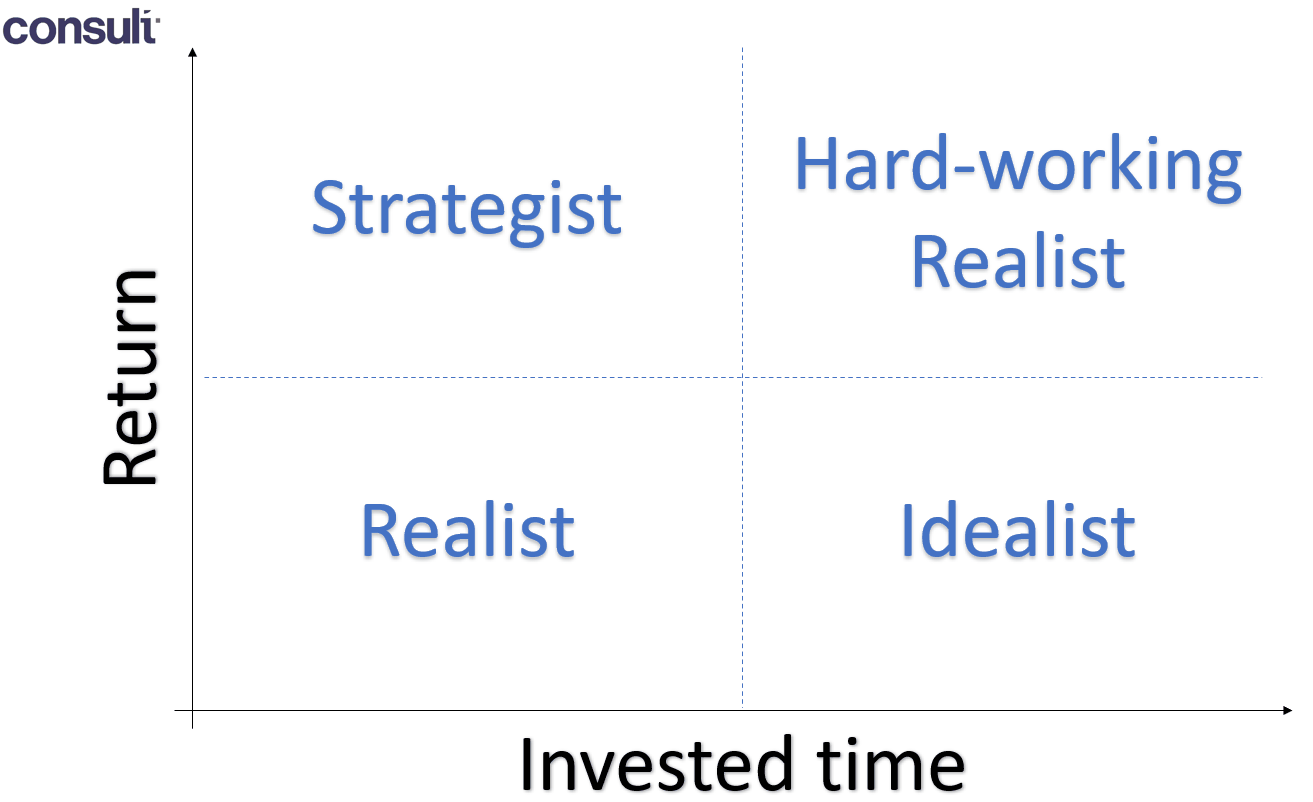
When you do your mapping on the topic you would like to tackle though this model, don’t waste too much time into calculating time, or the difference in resource value. This exercise should be intuitive, and detailed calculation will not bring you a different conclusion compared to a “rough” one.
Realist
Uses a small amount of available resources (also maybe as there is none) to generate a fairly small return with limited invested time. I call this quadrant “Realist” as in reality one does not expect a high return with no/small time investment, especially if there is no big idea, or a “secret sauce” included. Organization or business can also be “Realist”, for example, state owned companies or monopolies. Would you work for a “Realist”? Most probably it would be a “walk in the park” with a lot of free time, but possibly limited financial opportunities and personal development opportunities.
Idealist
Looks at the positive side of one’s story/idea/proposal, ready to invest huge amount of time and other available resources not prioritizing the actual return (on investment) before “jumping onboard”. Most of the successful entrepreneurs in the world started their journey in a “Idealist” quadrant, but after that transitioned to “Hard-Working Realist”, and “Strategist”. “Idealist” is in a lot of cases surrounding himself/herself with people alike but would clearly benefit from “Hard Working Realist”, “Strategist”, or even a “Realist”. Similarly, companies which operate as “Idealist”, would benefit from having a partner company positioned in the quadrant of “Strategist/Hard Working Realist”. For example, start-up company (e.g. “Idealist” company), would benefit from collaboration with the company which has a lot of other available resource (“Strategist” one) – a specialized consultant/investor maybe, but it could also benefit from the “Hard-Working Realist” company – for example, providing any sort of outsourcing service one should need.
Strategist
Uses the most out of other available resources with minimum time investment to gain maximum return. By nature/choice this person is ready to choose his organization/partners/partner companies carefully finding “hard working realist” or “idealists” as associates, ready to delegate to others, but also ready to make prompt decisions on its own.
Hard-working Realist
Invest everything in one’s idea – time + other available resources, and gains return accordingly. Hard working realist is a hard to cope co-worker, as someone who’s devotion to work is hard to match. Essential part for most of the successful organizations, but often a tough leader, straightforward both within and outside of the organization. Good in doing, average in motivating, not so prone to empower others.
Now that we have established different types of behaviors/personas for people and businesses, it is fair to mention that one can, over time, transition to different typology of behavior, moving in different directions. Similar to individuals, companies can also move to different typology of behavior (although rarely). Your company behavior is in direct correlation with the behavior of the majority of employees and the key internal stakeholders(informal and formal leaders and opinion creators). If you are not matching the company culture, there is high probability that you will be facing difficulties during your working time there. Companies often state they support diversity in behavior and business/entrepreneur thinking, but in reality, only few are actually “living what they preach”.
So, what are the key findings, are how they can help you improve ROIT over time?
1. You can have a preference to a certain behavior, but it is only a preference
You can change your stance through time, YOU are in control. None of these behaviors is wrong. Position yourself in the 2x2 table above with your current project/job, check where you were 10 years ago, and project yourself 10+ years ahead and explain why to yourself (why you prefer to have a certain behavior).
2. Prerogatives for above average return on invested time
This is simply a tradeoff between investing other resources (REMEMBER Skills, Capital and Network) and time, or how much other resources we (need to) invest to minimize time spent. Without the three, it would be absolutely necessary to invest extra time to deliver results. Have a midterm plan which is actionable, put targets and track progress, and realign targets as you go along in obtaining/growing your other resources.
3. If you are built for a center in basketball, that probably means that you are not fit to be a point guard
If you have a dominantly certain behavior, that will most probably mean you could dearly benefit from collaboration with individuals of opposite behavior. If you surround yourself with look-a-likes, most probably you will not be able to cope with different environments and (constant) change. In a 2x2 table, map of graph insert not only your position but also of your co-workers.
4. Be aware what is the behavior typology of the organization you work at, or you want to work at
If behavior typology of the organization your work/want to work at is different vs your own behavior preference, most probably you will face friction at work. Before joining, do a quick map of this company in the 2x2 table in order to better understand potential working environment, and decide whether you are OK with the possible friction(s), and check if that friction can be “traded” for other available resources.
5. Business-wise know your place, and where you want to be
If you are an active owner, or an active majority stakeholder, make a 2x2 analysis where your business stands but also where your competitors are. Why check where your competitors stand - there is a probability that the whole industry is in a certain quadrant. Also map out your key employees to understand which typology they fit in. Do you need diversity in your line of business? If yes, how you attract people that are different from majority you have, and how to keep them? What would be the actionable steps? Finally, be honest to yourself and make a plan where you want to position in future – prepare actionable plan and track the results.